Tuesday, 12 March 2024

Unit 16 - LO2 - P2 - Task One


How sound is produced

Task one

Foley sound / Wild tracks

Foley sounds are created and used to enhance the realism of a specific soundtrack – it’s a creative way to make the very subtle and minute sounds that an average boom mic is not able to pick up, and by adding them to your media product it adds a level of realism that the text wouldn’t have without it. Wild tracks are also very similar to foley sounds in the case that they aim to make the suspension of disbelief greater for the audience through the use of sound, by recording external sounds on set that can then be added in post as diegetic sound for a greater effect for the audience, such as the noise of a crowded street being added over a scene in a film. We can see 1:10 – 1:15 of this video, he uses a large 100 gallon pool of water to create the sound of water splashing, this may be used to reflect someone swimming in a film or something being dropped into water, and where a boom mic might not be able to pick it up, you’re able to get a greater of depth of sound when added here.


Theme music for a title sequence

Theme music that is used in a title sequence is a song or score that is specifically made for that media text. It is used to represent that media text and when someone hears the song, they will think back to that media text therefore making it more memorable. We can hear an example of theme music in the opening sequence for “Star wars” at 0:28 the theme music for star wars plays. This has made the movie itself easily memorable due to the music that accompanies the opening of the movie and makes it easier for the audience to get engrossed in the movie.

Film score

A film score is very similar to theme music for a title sequence in a film, however the film score usually accompanies the film the entire way and can be heard throughout the media text you’re watching. It is used not only to make the movie more memorable but also used to enforce emotion, as the music is made to specifically represent what the movie is; what its about and what it stands for. And when you hear that song that represents so much of a movie it creates a large amount of emotional magnitude in the audience. An example of this in a film is the film score for the movie “Jaws” where whenever the shark appears the film score can be heard. This represents the main movie’s intentions of fear and how the audience is meant to fear what’s going to happen whenever the music can be heard.

Character’s signature tune

A character’s signature tune is used much like the other tune type’s so far, it is used to represent a character and their motives through the music that is played alongside them. It adds to the character, and in some cases can even hint to somethings and can also act as a red herring such as playing ominous music on a character who we think is a murderer but it’s not them. An example of a signature tune being used is for “James Bond” as the music represents his spy themes, being a rather mysterious tone for the character but also represents all of the adventures he will go on and makes the audience appreciate the character more for the music that plays alongside him as it represents his motives.

Incidental music

Incidental music is background music that is intended to add atmosphere to the film or text, it does this by reinforcing what is currently happening in that moment, if it was to represent an upbeat atmosphere it would be upbeat music and visa versa. An example of this can be seen at 0:00 to 0:18 in this video where the music is being used to present the character as a laid back person who can easily explain things with ease. Through the correct use of incidental music you can use it to control the narrative of a film and make the narrative much easier to understand for the audience, it can also be used for narrative techniques such as red herrings, where the music is used to divert the audience in what they believe about the narrative.


Voice-overs

Voice overs in media can be used to make things much more clear, a voice over is where a person talking is added over the film in post to make explain something or give extra context to what is being shown, it is a very effective way to make the media text you have produced make more sense without having to make it too long while going into explanation. It also helps when there is no person present on the set that can explain things, or no dialogue in the film. We can see an example of this in “Planet Earth” where the person doing the voice over gives more context and information about what is being displayed, giving more information that wouldn’t of been accessible hadn’t it been there. Overall, voice-overs are a very effective way to make the audience more anchored into what is being shown, as it allows for the producers to make the audience get the preferred reading of the text they are displaying rather than the oppositional reading.

Tuesday, 5 March 2024

Unit 16 - LO1 - P1


Unit 16: How is sound used in media industries?


To Educate:

Sound is used in media industries in many cases to educate the audience about what they may be watching or listening to. An example of this in media is in documentaries via a narration, in this instance sound is used by the media industry to educate the audience about what is on screen at that moment in time, such as in the “Planet Earth” documentary which uses narration to talk about the wildlife that is being presented. Planet Earth is a documentary carried out by BBC 1 that talks about all things nature, it goes into detail about things such as forests and oceans and educates the audience about the world. Narration is the practise of adding a non-diegetic sound of a person talking over a video such as “We begin in the oldest desert on earth – the Namib in South west Africa.” This allows for the audience to give a better understanding of what is happening and allows them to learn things in more depth, and with how much may be happening in an in-depth show such as Planet earth, having a narration to help the audience with what is happening on screen allows them to actually understand how things work with the help of a trained professional. Overall this allows the audience to become more educated about what they’re watching in contrast to if there wasn’t a narration, as for things that are more in-depth, a simple verbal display may not be enough.


To Inform:

In media industries sound is also used to inform the audience about what may be happening through reports. An example of this would be how the news industry such as “BBC News” has reports on things that are happening. BBC News is a news outlet made by BBC that uses reports to inform the consumers of their media about things from the weather of that day to foreign affairs that are currently happening. A report is when someone gives a spoken account about something they have investigated and allows them to inform the audience, this can be seen in BBC News’ 6th of March 2024 episode where it was stated that “Chancellor Jeremy Hunt will deliver the Budget today, outlining the government's tax and spending plans.” This report on the budgeting situation informs the audience that are listening to the news report that Jeremy hunt is going to deliver the budget on the governments tax plans, this gives them information that they usually wouldn’t just come across and allows them to know about something they previously wouldn’t of. Overall, the news industry uses reports to inform the audience of many things that may be happening across the world and acts as a efficient way to tell people about what’s happening.


To Entertain:

Media industries also use sounds in their products to create a sense of entertainment. They do this through the use of sound effects and jingles. An example of this would be in BBC Radio 4’s “The Archers” which use jingles and sound effects to create a suspension of disbelief for the audience. A jingle is a catchy musical tone or audible slogan that is used to represent your show, The Archer’s use their jingle in order to crate a setting that fully pulls the audience into their show, it acts as a gateway into the episode and prepares their audience for what is going to happen, therefore entertaining the audience. Sound effects are small audio mp3 files that are played throughout the episode to add to the suspension of disbelief as well, they are used by industries to add to the setting such as in the 29.01.24 episode of the archers where at 0:50 of the episode we can hear that we’re outside with the characters due to a bird chirping sound effect that is playing. Overall, the industries use sound to create a suspension of disbelief which helps the audience gets involved in the episode and get more entertained by the actual episode as The Archers treats their audience as characters as well.


Sell products:

Media industries that are trying to sell a product also use sound to make users more familiar with their product, which makes them come back to the product. An example of this is how industries will use the same music in their advertisements in order to sell their product. Advertisements are displays of commercial goods that a company is trying to sell, and usually is seen in either written or video form; when a company uses a video advertisement it will usually be accompanied by a catchy tune that plays alongside the advertisement. We can see this in trailers when a film company is trying to sell their movie, the company behind the movie “Skyfall” uses the song with the same name “Skyfall” to promote their movie by making the audience familiarised with the movie through the song that is always played in the trailers. This gets the song stuck in their head and makes them thing about the movie whenever the remember the song.


Wild tracks:

Media industries will use wild tracks much similarly as they use sound in entertainment, many companies use wild tracks to create a greater suspension of disbelief in the audience to get them more involved in the media they are taking in. An example of this is the “Block breaking” sound effect used by the games company “Mojang” in their game Minecraft. The use of this sound in their game creates a better form of suspension of disbelief as it adds to the realism of the game. While the game is clearly fictional due to its abstract art style, the fact that we can physically hear the progress of us breaking a material in the game adds to the realism of the game and makes the audience more involved in what they’re doing.


Atmospheric Sounds:

Atmospheric sounds are used by companies in order to make the audience more indulged in the media they’re consuming, its used across many corners of media from movies to video games and allows for the audience to fall further into suspension of disbelief as it adds realism to the environment they are digitally being introduced to. An atmospheric sound may be a sound effect that is used to match the environment that a character might be in, or it may be a music score made by a producer to match the emotions that are being portrayed in the media and this allows for the audience to feel as if the environment that their characters are in is more real as if it didn’t have any atmospheric sounds. We can see this used in the Netflix original movie “Spaceman” which uses sound in order to reflect the emotions of the main character “Jacub”.


Sound effects:

Many media industries use sound effects in order to convey something or create meaning. We can see this in horror movies when they use sound effects to create tension in their media, an example of a horror movie where they use sound effects in a movie is in the movie “Evil dead rise” where they use the sound effect of wet feet steps to imitate a floor being covered in blood, to reflect the massacre that had happened previously. This creates a more realistic setting for the audience as we see that there is blood splattered which makes the audience more enveloped in the movie they’re watching and creates more tension for the audience.


Dialogue:

Dialogue is the use of a conversation in media, people can use this to build character in films or games and allows for the audience to understand whats happening. An example of this being used is in “Deep Blue sea” where Samuel L Jackson gives a speech which builds confidence in the other characters, this conveys to the audience the emotions which is currently happening in this movie such as the panic which can be felt in this movie when he is giving his speech.


Music:

Music is used to specifically anchor meaning in media texts, it allows for the audience to build on what’s already happening in the text at that point and builds on whatever is needed, such as emotion or meaning. An example of this would be the use of the song “Dreamer” in the advert for the apple vision pro. The use of this song is symbolic as it allows for the audience to feel as if the product is for people who want to dream big and this song anchors that meaning into the product as it allows for the audience to feel as if the product makes you able to live your dreams.


To enhance visuals:

Sound is also used in many cases to enhance visuals, this means that the audio that is played reinforces the visuals of what’s happening in scene through post-production editing. Many media industries may do this as some of the sounds they wanted couldn’t be made in the actual recording and therefore they record the sound exteriorly and add it to the film. One example of this are the hammering sounds in the “Iron Man” movie, by using the sound of a hammer hitting metal gives the effect that actual effort went into crafting this suit of armour, where in reality it probably didn’t sound like that before post production. Another example of  sound being used to enhance the visuals of a media text is in “Star wars attack of the clones” where we can hear the non-diegetic sound of the two lightsabres hitting each other, while we know this is a fictional sound that has bene added in post, the use of it to add to the realism of the lightsabres crashing into each other makes the visuals much greater as we can be lead to believe that they are actually clashing which makes the effect greater for the audience.


Use of silence:

Finally, many industries also use the sound of silence to create a meaning in their media text, they do this to reflect not only emotional aspects but physical aspects of the media text; this can be seen in the movie “A quiet place” to reflect the audible impairments of one of the characters. In this movie, making noise can kill you therefore any diegetic sound that can be heard builds suspense for the audience, however the fact that a sound is currently being made but we can’t hear it as the audience is an effective way to build even more tension as the person who is deaf cannot hear what is happening but has to see it in order to understand.

Sunday, 4 February 2024

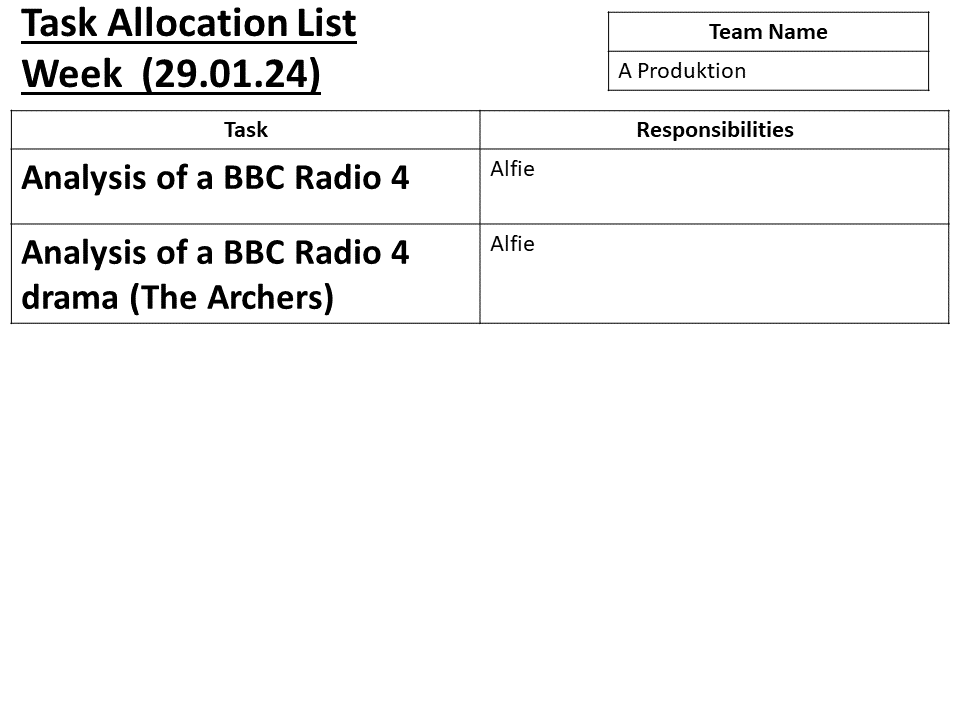
Task Allocation Week 2


Production Log Week 2


Unit 14 - LO1 - P2


Programme Analysis


“The Archers” is a radio drama on the BBC that mainly focuses on farming. They release two episodes per day with one being released at 2pm and another at 7pm which are each 13 minutes long. However, on Sunday, they release a one-hour episode called an “Omnibus” which is a one-hour episode that is a collection of all the episodes released in that week. This makes it so people who aren’t able to watch the episodes throughout the week are able to catch up on the narrative as each episode leads into the next. The audience are able to access the show mainly on the BBC website however there are other services such as Spotify and TuneIn that allow for audiences to listen in as well.

 The episode starts by the host announcing the episode and then it plays their opening theme song, it then goes right into the dramatisation. It then plays out the narrative of the episode which for the 29/01/24 episode is the narrative of the characters cleaning the car and trying to open up the pub. They start with them being inside the pub fixing things where it then shifts to two characters who are cleaning a car. They then cut back to inside the pub where they’re talking about how they will be able to open up the pub again where the characters from that scene then join up with the characters from the car washing scene to tell them that the pug is going to be opened. Noises are used in the next scene to display that we are now in the pub when it has opened and that time has passed. We then proceed into another scene where the two pub owners are talking about opening the pub being the correct decision however this scene only lasts a little bit as we then cut again to the main portion of the pub where they’re talking about a beer drinking competition. We then cut to a scene where they announce the winner of the drinking competition and with that the episode concludes and their outro music plays.

The archers aim to fulfil all three declarations in the BBC’s ethos. To Inform, educate and entertain. First of all, they inform with their audience by presenting them with real life news that may currently be occurring. We can see this in the episode aired on the 11th of September 2022 at the very start of the first narrative as it talks about the death of the Queen, informing the people about her death. It educates the audience about things that they not know about, we can see this in their episode about domestic abuse where they act out a situation where domestic abuse was taking place to display what a situation like this may be like. And finally, they entertain through most of their episodes, whether this is through jokes as seen on the 29/01/24 episode at 05:55 where they play around splashing each other with soap and bubbles.

The episode starts by their host Roifield Brown announcing that the 29/01/24 episode is Monday’s episode of The Archers and that its on BBC 4. This then transitions into their theme song that plays for 15 seconds and then fades for 5 seconds into the first narrative. The first scene starts with scrubbing noises as we learn that someone called “Tracey” is cleaning another character called “Jolene’s” car. We learn that we are outside at 0:50 as another diegetic foley sound is played in the form of birds, creating the feeling that the audience is outside with the characters. They then start talking about how the pub is getting its outside done and the doors are getting renovated. The colloquial language used by each character makes it seem as if we are a person just listening to their day-to-day conversation, it doesn’t make it seem that we are audience and the use of diegetic sounds to convey this. The scene then changes to Jolene and Kenton in the pub talking about how, apart from the electrics, they will be able to start the pub back up, which is promptly followed to another scene of Jolene and Kenton coming outside to Tracey and Emma washing her car. Tracey is trying to splash Emma with water saying that she hasn’t helped her and we promptly hear her do so due to the diegetic sound of laughter and splashing noises assuming that the water is being thrown. The two then get told that they will be able to open up the pub again and we can physically hear a sound of joy, making the audience listening at home feel happy for the pub workers as they eagerly say that they will go home and put on their work clothes while also spreading the word that the pub is opening again. After this display of joy, we then have a time jump, where we are now in the pub. We know this due to the use of diegetic noise to reflect that of a bustling establishment, with noises of glasses linking them ringing for an order. We hear them talking about how they’re going to take the empty glasses out back and they then start discussing how they should announce the winner of the drinking competition, Kenton asks everyone to be quiet where he then promptly announces the winner. This ends the episode and it is then followed out by the end music which slowly fades away. Throughout the episode there are no breaks and no more narration other than the announcement at the very start, this makes for a flowing episode where people can listen to 13 minutes about everything that is happening.

The programme uses sound to give the effect that the audience is actually with the character. They do this in multiple ways, one of which we can see in the 29/01/24 episode where when Emma and Tracy are talking to each other we are able to hear the diegetic noise of birds chirping in the background, this makes the audience feel as if they’re actually outside washing the car with them instead of just being listeners. This allows for them to be more enticed in the episode and allows for a more personal experience while listening to the episodes. There is another example of this via their theme song – their theme song acts as a gateway into the episode allowing the audience to fully immerse themselves into the episode via the theme song. It has become a staple of the show and allows for the audience to recognise the show from just listening to it, meaning that whenever they hear the theme song, they instantly correlate it to.


Rushes Video